Playa Ocotal: A Local’s Guide to the Beach Below the Villa

Most people arrive in Guanacaste with a list of beaches they have read about — Tamarindo, Conchal, Flamingo — and Ocotal is not usually on it. That is the best thing about it.

This is the beach below the villa. Here is what it actually is, and what it is not.

A small dark cove with rocks at both ends

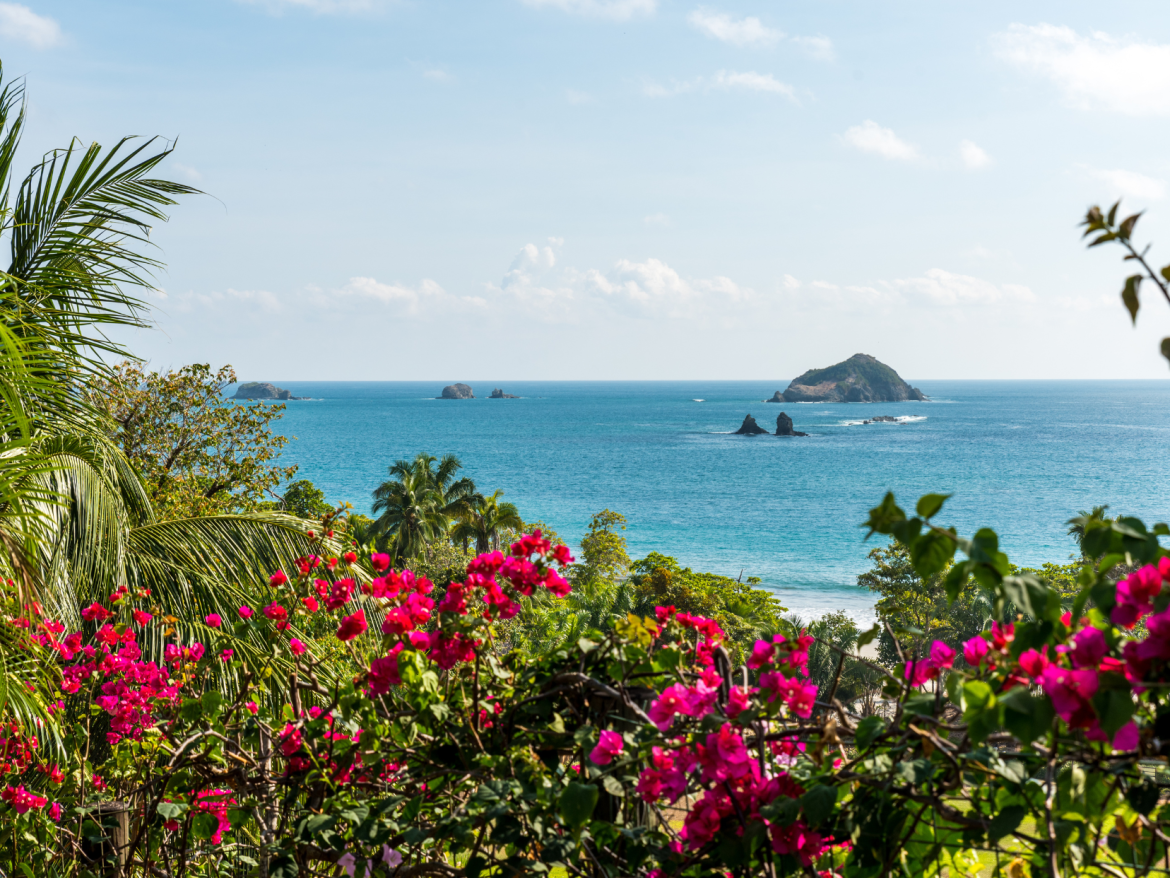
Ocotal is about a third of a mile long, a shallow crescent set between two rocky headlands with a small island sitting off the southern point. Hills and cliffs come down close behind it, which is why it has stayed small: there is not much room to build a strip.

The sand is dark. Guidebooks call it black; charcoal is closer. It is volcanic in origin, and in places you can see lighter sand underneath where the surface has been disturbed. It photographs moodier than the postcard beaches to the south and it looks spectacular in the hour before sunset.

The headlands do most of the work on the water. The cove is sheltered, waves are usually small, and it is a straightforward beach for families. Not always glass — conditions shift, and some days bring medium waves and chop — but it is not a surf beach and it does not pretend to be.

Snorkelling: go right

The rocks at either end hold fish, and the right-hand side of the beach is the better of the two. Plenty of small tropical species, tide pools at low water, and it is genuinely worth an hour with a mask.

An honest caveat, because we would rather you knew: Pacific visibility in Costa Rica is variable and drops sharply after rain — sometimes to nothing. The reliable window is late December to mid-April. In green season, check the water before you commit the afternoon to it.

Ocotal is also a launch point for better diving than its own reef: Monkey Head Rock, the Catalina Islands, and the Bat Islands further north, which is where the bull sharks are.

One practical warning. Manchineel trees back parts of this beach. Do not shelter under them in rain and do not touch the fruit — the sap blisters skin. They are common on Central American coasts and worth being able to recognise.

Two restaurants on the sand

Father Rooster has been on this beach since 1985 — an old hacienda building, feet in the sand, the place everyone ends up at some point during the week. Casual, loud, good.

Picante, inside the Bahía Pez Vela resort at the southern end, is the upscale option — seafood, and the view you would expect.

Neither of them requires planning. That is the character of this beach.

Five minutes to everything else

Playas del Coco is 3 kilometres up the road — about five minutes. It has what Ocotal deliberately does not: supermarkets, banks, a long beachfront boardwalk with parks and playgrounds, a working marina with fishing boats and sailboats, dive shops, catamaran operators, and a restaurant scene that runs from sodas to Mediterranean, Indian, Greek and Italian. Its beach is a longer, calmer crescent with dark tan sand.

The practical division that most of our guests settle into: Ocotal for the day, Coco for whatever you need.

Groceries in Coco are covered by Auto Mercado in Pacifico Village for the good stuff, Super Compro downtown for staples, and Luperon across the road for bulk. There is a Sunday market at Hotel La Puerta del Sol, nine to two.

Worth the drive

Everything below is measured from Ocotal, and they are published estimates rather than stopwatch times.

  • Playa Hermosa and Playa Panamá — 10 to 20 minutes. Calmer, wider, good for a change of scene.
  • Diamante Eco Adventure Park — about 35 minutes. Zip lines and an animal sanctuary; open daily 8:30 to 4:30.
  • Las Catalinas — about 45 to 50 minutes. A car-free planned town with excellent restaurants and trails. Worth a lunch.
  • Playa Conchal and Flamingo — about an hour. Conchal’s “sand” is crushed shell, and it is as strange and beautiful as advertised.
  • Llanos de Cortés waterfall — about an hour, near Bagaces. Wide, swimmable, no ticket booth — donations support the local school.
  • Rincón de la Vieja — about an hour and twenty-five minutes. Mud pots and fumaroles. See the note below.
  • Tamarindo — about an hour and a half. Busier, surfier, more nightlife.

On Rincón: the volcano has been at alert level 3 of 4 since July 2026 after a run of phreatic eruptions. The park operates normally and the Las Pailas mud-pot loop and waterfall trails are open; the summit crater trail is closed and has been for years. Tickets are online-only now. We will confirm status before booking anything for you.

Getting around without a car

Plenty of our guests do. Ocotal to Coco is a $5-ish taxi or a 45-minute walk. The house manager arranges excursions with pickup at the door, which removes the parking problem at every destination on the list above. A rental car makes sense if you want to be spontaneous about beaches; it is not necessary otherwise.

Sunset

You have two options and they are different.

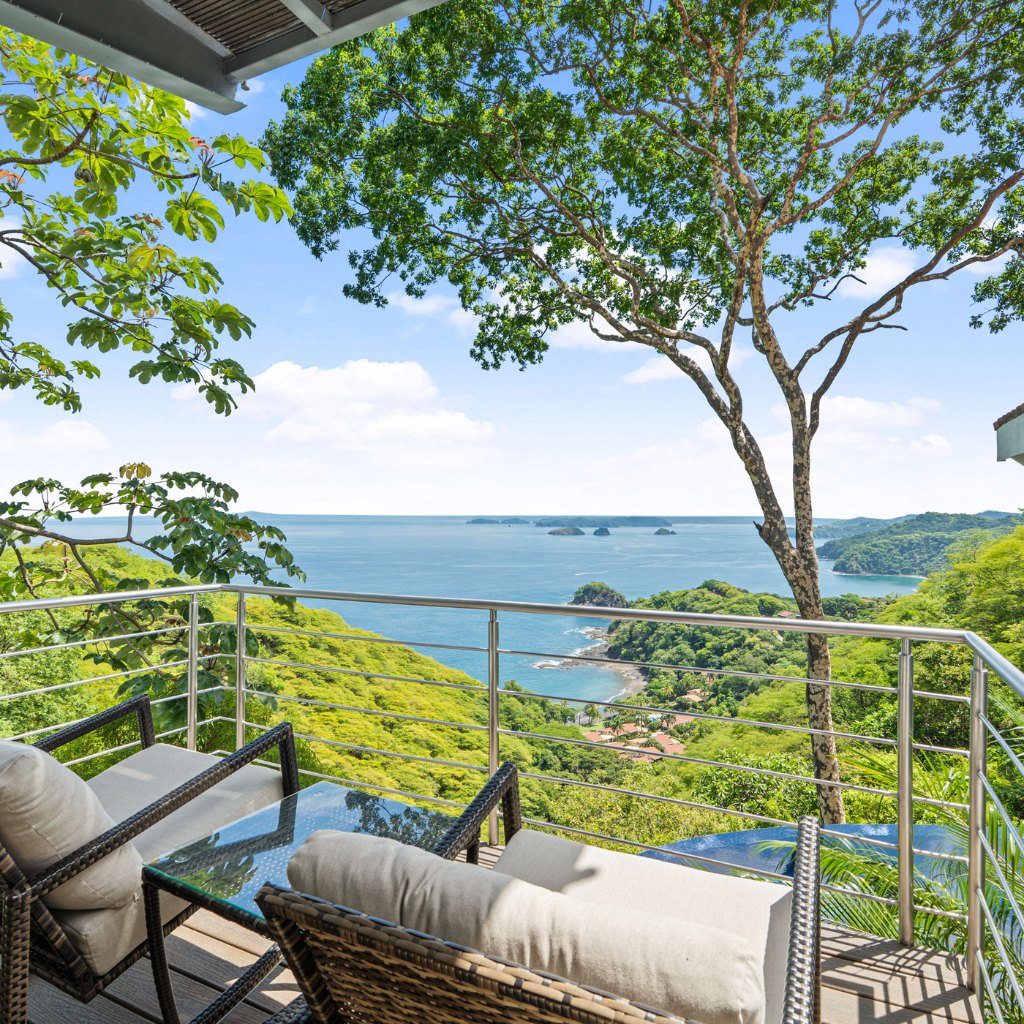
From the sand, the sun goes down between the headlands and the whole cove goes orange. From the hillside above — from our terrace — you see the curve of the coast, the islands, and the light on the water all the way out. Sunset here runs between about 5:20 and 5:45 depending on the month, and tropical twilight is short: full dark comes about twenty-five minutes after.

Which is a long way of saying, do not plan to be anywhere else at five o’clock.
See what there is to do here → · Check available dates →

Birdsong, Logged: The BirdWeather Station at Mar-a-Selva

At three in the morning the hillside above Playa Ocotal is not quiet. It is only unlistened to.

There is a small weatherproof box in the trees at Mar-a-Selva that does the listening on our behalf. It has been running since 17 June 2025. In that time it has heard 158 species and written down 91,623 individual calls, and it has not slept once.

Birdwatching in Costa Rica usually means a guide, a five a.m. alarm and a long drive. Here it also means this: you can see what the hillside is saying right now, from wherever you are reading this, before you have booked a single night.

Live from station #15022 · Playa Ocotal

What the hillside is hearing

—Species all time
—Detections
—Species this week
—Last 24 hours

Loading live data from the station…

Heard in the last 24 hours

  • Loading…

Most recorded, all time

  • Loading…

Open the live station

BirdNET identifies birds by sound, not by sight. An unusual entry is a detection, not a confirmed sighting — the raw audio for every one is public on the station page.

What the box is

A BirdWeather PUC — two microphones, a GPS and a stack of environmental sensors, running a neural network that recognises more than 6,400 species by sound in real time. The model is BirdNET, a research collaboration between the Cornell Lab of Ornithology and Chemnitz University of Technology. There are over two thousand of these stations worldwide. Ours is number 15022, and every detection it makes is public. No account, no subscription.

The day is split between two voices

The most striking thing in fifteen months of data is how evenly the twenty-four hours are divided, and by whom.

The Great Kiskadee owns the daylight: 28,538 detections. It says its own name, repeatedly, from an exposed branch, at volume, and it starts before you would like it to.

The Pacific Screech-Owl owns the dark: 28,181. Within a rounding error of the kiskadee. Most guests never see one. Everybody hears them.

Two birds, almost exactly half the record each, handing the hillside back and forth at dawn and dusk. That is the soundtrack of the house, quantified.

Third place, and the bird you will actually meet, is the White-throated Magpie-Jay — big, blue and white, absurdly crested, and loud. They travel in gangs and scold whatever they dislike. They are omnivores with poor manners: insects, nectar, fruit, and the nestlings of other birds. They will raid a papaya the day before you meant to pick it. After that the dry-forest cast fills in: Common Pauraque calling from the road at dusk, Rufous-naped and Banded Wrens, Tropical Kingbird, Boat-billed Flycatcher, White-fronted Parrots going over in pairs, Squirrel Cuckoo, Lesser Ground-Cuckoo, Collared Forest-Falcon.

Right now, the list is changing

Autumn does something to the register. A Belted Kingfisher has been working the shoreline this week — the station has logged that species 56 times in its whole history, and 21 of those were in the last seven days. Ospreys are back over the water. A Broad-winged Hawk came through at midday. Somewhere out there is a Ruby-throated Hummingbird that weighs as much as a penny and has just arrived from a feeder in North America.

We wrote about that separately: which northern birds are arriving at Mar-a-Selva right now.

The one everyone wants to see

The Turquoise-browed Motmot, and the station picks it up regularly.

Green and blue and black with an orange breast, and two long central tail feathers stripped bare except for racquet-shaped tips. Both sexes swing that tail slowly side to side — in males during breeding it is courtship; otherwise it appears to be a signal to a predator that it has been seen. They nest in burrows they dig into ravine banks, tunnels a few inches wide and up to eight feet deep. They are mostly a Guanacaste bird, they perch conspicuously on wires and fence posts, and they are famously unbothered by people. The local name is pájaro bobo — roughly, the foolish bird — for exactly that reason.

One correction worth making, because it is repeated constantly: the motmot is not Costa Rica’s national bird. It is the national bird of El Salvador and Nicaragua. Costa Rica’s is the Clay-colored Thrush — the yigüirro — a plain brown bird whose song is said to call in the rains.

Also on the list and worth watching for: Black-headed Trogon, Elegant Trogon, Orange-fronted Parakeet, Hoffmann’s Woodpecker, and, occasionally, a Streak-backed Oriole.

What the machine gets wrong

We are going to be straight about this, because it is more interesting than pretending otherwise.

The species list is not a clean checklist. Sitting on it are a handful of birds with no business on a Guanacaste hillside — a House Sparrow, an Acorn Woodpecker, a Montezuma Oropendola. Those are almost certainly misfires: a sound that resembled something else, a confident model making a call it should not have. Every detection carries a confidence score, and reading them critically is half the fun.

Meanwhile some real birds of this forest have never turned up at all. The Long-tailed Manakin — saltarín toledo, named for its to-lay-do call, where two or three males perform a cooperative dance for a single female — lives in Guanacaste forest, and our box has not caught one. Nor has it logged a Ferruginous Pygmy-Owl, which is a shame, because it is the bird every songbird in the neighbourhood hates: one study recorded up to forty birds of eleven species mobbing a single owl.

Absence in the data is not absence from the hill. It only means nothing called within range of two microphones.

The thing that isn’t a bird

You will hear mantled howler monkeys before you are properly awake, and you will think something large is coming for the house. It is a leaf-eating monkey the size of a raccoon whose call carries more than a kilometre.

There is a reason for the volume. Howlers live on leaves, which is a poor diet to fund a fight — so they settle territorial disputes by shouting across the valley rather than crossing it. The noise is the entire strategy.

Why the hillside and not the beach

Mar-a-Selva sits up in the trees above Playa Ocotal, and that elevation is the whole reason the station has anything to report. The beachfront is open and built on. Up here it is dry forest — thick in green season, bare and bright in March, and full of things that call.

Bring binoculars. The best hours are the first two after dawn and the last one before sunset, which falls somewhere around 5:20 to 5:45 depending on the month.

And before you come, go and look at what the box is hearing today. It is the most honest preview of a place we know how to give you.

Open the Mar-a-Selva station · Check available dates

The Commute: Which Northern Birds Are Arriving at Mar-a-Selva Right Now

A Belted Kingfisher has been rattling along the shoreline below the villa all week. That is not remarkable in itself. What is remarkable is the arithmetic: the acoustic station on our hillside has recorded that species 56 times in its entire fifteen-month history, and 21 of those detections happened in the last seven days.

Something changed. The kingfishers came back.

The hillside keeps a register

Mar-a-Selva has a BirdWeather station in the trees above the pool. It listens around the clock and identifies birds by sound, and because it never stops, it notices things a person would miss — including the exact week a species reappears after half a year away.

Here is what it is hearing at this moment. These numbers are live; they will not match by the time you read this twice.

Live from station #15022 · Playa Ocotal

What the hillside is hearing

—Species all time
—Detections
—Species this week
—Last 24 hours

Loading live data from the station…

Heard in the last 24 hours

  • Loading…

Most recorded, all time

  • Loading…

Open the live station

BirdNET identifies birds by sound, not by sight. An unusual entry is a detection, not a confirmed sighting — the raw audio for every one is public on the station page.

Guanacaste is the far end of the commute

Every autumn a substantial share of North America’s birdlife leaves. Not for Florida — for here, and for places like here. Central America is where a great many of them spend the half of the year nobody back home sees. They arrive in Guanacaste from roughly late August through November, settle into the dry forest, and leave again in March and April.

The birds you lost track of at the end of the summer are not gone. They are commuting, and this is the other end of the line.

Who has turned up in the last seven days

Straight off the station, with nothing smoothed out:

  • Belted Kingfisher — 21 detections this week. The clearest arrival signal on the board.
  • Osprey — heard over the water at 6:59 in the morning. They fish this coast all winter.
  • Broad-winged Hawk — one high-confidence detection at 11:50 a.m. These are the birds that stream south in kettles of thousands; a few peel off here.
  • Ruby-throated Hummingbird — three detections. A bird that weighs about as much as a penny, arriving from a garden feeder somewhere north.
  • American Kestrel — two, one just after five in the morning.
  • Swainson’s Thrush, Eastern Wood-Pewee, Least Sandpiper, Whimbrel, Northern Rough-winged Swallow — one apiece, all at lower confidence. Read those as maybes.

And who is already settled in

Some of the winter residents have been on the station’s books for months and are now part of the furniture. The Summer Tanager is the standout — 694 detections all time, a bird that breeds across the American South and spends its winters in exactly this kind of forest. Behind it, the Great Crested Flycatcher (595), the Yellow Warbler (336), the American Redstart (65), and, occasionally, a Western Tanager that took a wrong-ish turn.

If you have a Summer Tanager in your yard in Tennessee in July, there is a real chance it is standing in our trees in January.

A word on what the machine gets wrong

BirdNET, the model behind the station, identifies birds by sound alone, and it reports a confidence score with every call it makes. The kingfisher and the Broad-winged Hawk came in high. The sandpiper and the wood-pewee came in barely over the line, which means they are suggestions, not records.

We publish them anyway, because the raw audio for every detection is public and you can go and listen yourself. Sorting the certain from the doubtful is not a flaw in this kind of monitoring. It is the activity.

Why October and November are the good months for this

Arrivals peak while the forest is still green from the rains, which is the opposite of what most people picture when they imagine Costa Rica in the dry season. The hills are thick, the light is soft in the mornings, the beaches are empty, and the species count on the station climbs week over week as the northern birds filter in.

The best hours are the first two after sunrise and the last one before sunset, from a terrace, with coffee or without. Bring binoculars. The list is on the wall, and it is being written tonight whether anyone is here to read it or not.

See what the station is hearing right now · Check open dates

Embracing Costa Rica’s Rainy Season: A Unique Travel Experience

Traveling to Costa Rica between May and November offers a distinctive opportunity to experience the country’s lush landscapes and vibrant culture in a different light. Often referred to as the “green season,” this period is characterized by rejuvenated nature, fewer tourists, and a plethora of activities that showcase the country’s natural beauty.​ If you’re staying at Mar-a-Selva, this season brings a quieter, more immersive side of the country right to your doorstep.

Continue reading “Embracing Costa Rica’s Rainy Season: A Unique Travel Experience”