Playa Ocotal: A Local’s Guide to the Beach Below the Villa

Most people arrive in Guanacaste with a list of beaches they have read about — Tamarindo, Conchal, Flamingo — and Ocotal is not usually on it. That is the best thing about it.

This is the beach below the villa. Here is what it actually is, and what it is not.

A small dark cove with rocks at both ends

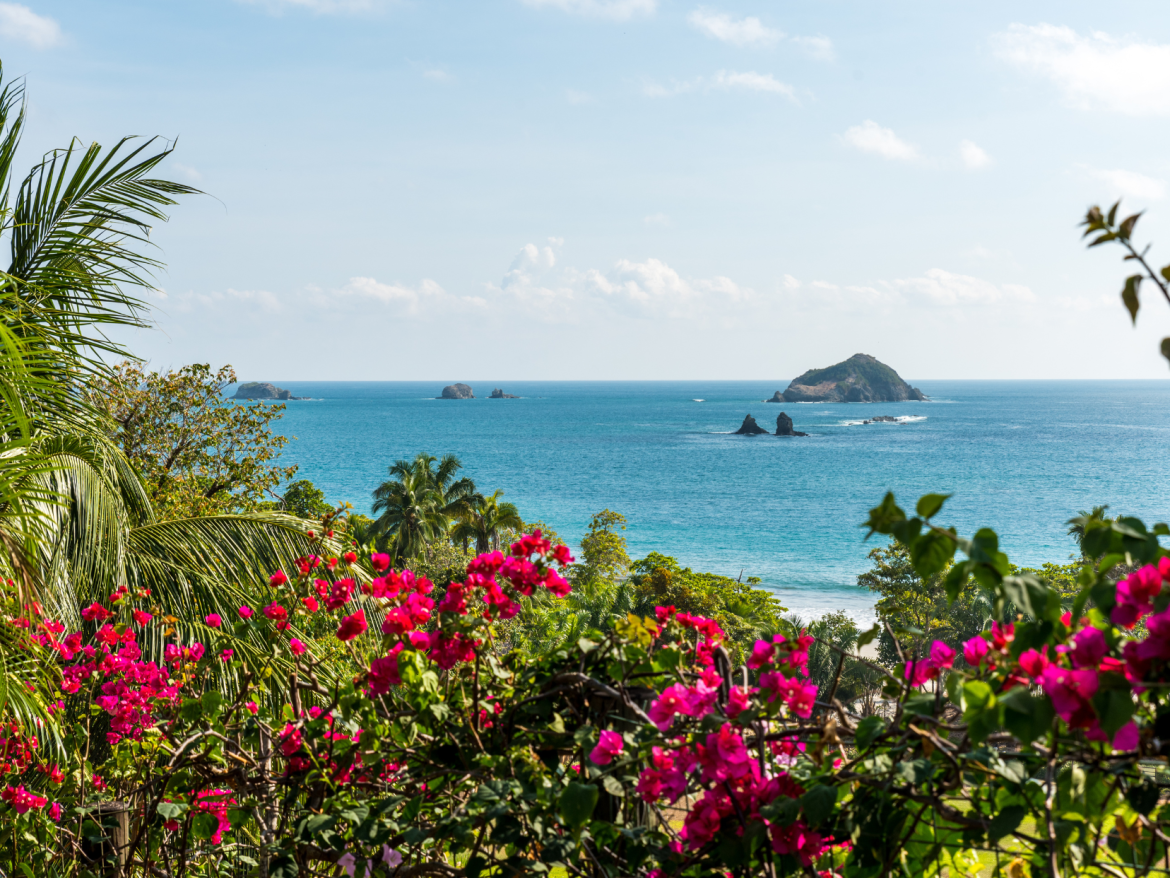
Ocotal is about a third of a mile long, a shallow crescent set between two rocky headlands with a small island sitting off the southern point. Hills and cliffs come down close behind it, which is why it has stayed small: there is not much room to build a strip.

The sand is dark. Guidebooks call it black; charcoal is closer. It is volcanic in origin, and in places you can see lighter sand underneath where the surface has been disturbed. It photographs moodier than the postcard beaches to the south and it looks spectacular in the hour before sunset.

The headlands do most of the work on the water. The cove is sheltered, waves are usually small, and it is a straightforward beach for families. Not always glass — conditions shift, and some days bring medium waves and chop — but it is not a surf beach and it does not pretend to be.

Snorkelling: go right

The rocks at either end hold fish, and the right-hand side of the beach is the better of the two. Plenty of small tropical species, tide pools at low water, and it is genuinely worth an hour with a mask.

An honest caveat, because we would rather you knew: Pacific visibility in Costa Rica is variable and drops sharply after rain — sometimes to nothing. The reliable window is late December to mid-April. In green season, check the water before you commit the afternoon to it.

Ocotal is also a launch point for better diving than its own reef: Monkey Head Rock, the Catalina Islands, and the Bat Islands further north, which is where the bull sharks are.

One practical warning. Manchineel trees back parts of this beach. Do not shelter under them in rain and do not touch the fruit — the sap blisters skin. They are common on Central American coasts and worth being able to recognise.

Two restaurants on the sand

Father Rooster has been on this beach since 1985 — an old hacienda building, feet in the sand, the place everyone ends up at some point during the week. Casual, loud, good.

Picante, inside the Bahía Pez Vela resort at the southern end, is the upscale option — seafood, and the view you would expect.

Neither of them requires planning. That is the character of this beach.

Five minutes to everything else

Playas del Coco is 3 kilometres up the road — about five minutes. It has what Ocotal deliberately does not: supermarkets, banks, a long beachfront boardwalk with parks and playgrounds, a working marina with fishing boats and sailboats, dive shops, catamaran operators, and a restaurant scene that runs from sodas to Mediterranean, Indian, Greek and Italian. Its beach is a longer, calmer crescent with dark tan sand.

The practical division that most of our guests settle into: Ocotal for the day, Coco for whatever you need.

Groceries in Coco are covered by Auto Mercado in Pacifico Village for the good stuff, Super Compro downtown for staples, and Luperon across the road for bulk. There is a Sunday market at Hotel La Puerta del Sol, nine to two.

Worth the drive

Everything below is measured from Ocotal, and they are published estimates rather than stopwatch times.

  • Playa Hermosa and Playa Panamá — 10 to 20 minutes. Calmer, wider, good for a change of scene.
  • Diamante Eco Adventure Park — about 35 minutes. Zip lines and an animal sanctuary; open daily 8:30 to 4:30.
  • Las Catalinas — about 45 to 50 minutes. A car-free planned town with excellent restaurants and trails. Worth a lunch.
  • Playa Conchal and Flamingo — about an hour. Conchal’s “sand” is crushed shell, and it is as strange and beautiful as advertised.
  • Llanos de Cortés waterfall — about an hour, near Bagaces. Wide, swimmable, no ticket booth — donations support the local school.
  • Rincón de la Vieja — about an hour and twenty-five minutes. Mud pots and fumaroles. See the note below.
  • Tamarindo — about an hour and a half. Busier, surfier, more nightlife.

On Rincón: the volcano has been at alert level 3 of 4 since July 2026 after a run of phreatic eruptions. The park operates normally and the Las Pailas mud-pot loop and waterfall trails are open; the summit crater trail is closed and has been for years. Tickets are online-only now. We will confirm status before booking anything for you.

Getting around without a car

Plenty of our guests do. Ocotal to Coco is a $5-ish taxi or a 45-minute walk. The house manager arranges excursions with pickup at the door, which removes the parking problem at every destination on the list above. A rental car makes sense if you want to be spontaneous about beaches; it is not necessary otherwise.

Sunset

You have two options and they are different.

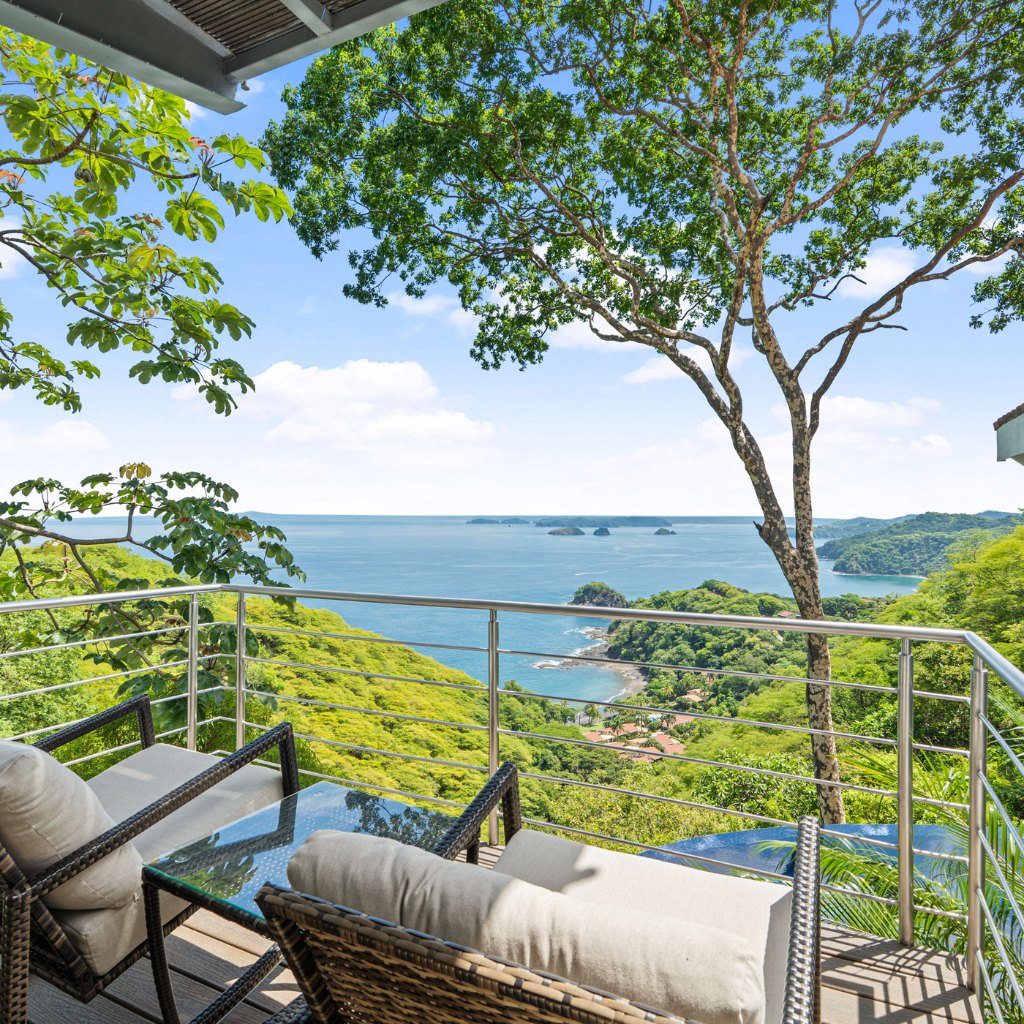
From the sand, the sun goes down between the headlands and the whole cove goes orange. From the hillside above — from our terrace — you see the curve of the coast, the islands, and the light on the water all the way out. Sunset here runs between about 5:20 and 5:45 depending on the month, and tropical twilight is short: full dark comes about twenty-five minutes after.

Which is a long way of saying, do not plan to be anywhere else at five o’clock.

See what there is to do here → · Check available dates →

A Private Chef Week at Mar-a-Selva: Seven Dinners, Zero Reservations

The thing guests underestimate about a private chef is not the food. It is the absence of a daily decision.

On a normal beach vacation, somebody in the group is on their phone at 5:30 every afternoon trying to find a table for eight that is open, good, and not forty minutes away. Then everyone gets in cars. Then the kids melt down somewhere around the appetisers. That is four or five hours a day, every day, spent on logistics for a thing you do three times a day at home without thinking about it.

Here, dinner happens. You are on the terrace, the sun is going down over the Pacific, and somebody hands you a plate.

What a week actually looks like

Menus are built around what your group tells us and what came off the boat that morning, so this is an illustration rather than a fixed rotation. But it is a real week.

Arrival night. Something easy, because you have been travelling. Ceviche while you unpack, then grilled fish and rice. Tico ceviche is not Peruvian ceviche — the fish cures in lime for hours rather than minutes, sometimes overnight, with onion, sweet pepper, cilantro and garlic. It comes out firm and opaque rather than translucent. Corvina and shrimp are the standards.

Day two: casado, done properly. The national lunch plate — rice, black beans, a protein, salad, sweet fried plantain, maybe avocado and a tortilla. Ours usually comes with red snapper, which is landed just down the coast. It is the dish people are most surprised to love.

Day three: lobster. A question we get: is there a closed season? Not on this coast. Costa Rica’s Pacific lobster is regulated by minimum size, not by calendar — the March-to-June closure you may have read about is a regional rule for Caribbean spiny lobster, on the other side of the country.

Day four: the long lunch. Somebody always takes a day trip, so dinner goes light and lunch goes big — chifrijo, which the Tico Times fairly calls “the king of Tico bar food”: rice, beans, chicharrón and pico de gallo layered in a bowl with tortilla chips. It was invented in a San José bar and is now everywhere.

Day five: mahi. Dorado is most active in local waters from May through September, and the recreational-fishery data shows it trending up rather than down — one of the few good-news stories in sport fishing right now. If somebody in the group goes out with a boat from Coco, we cook what they bring back.

Day six: Guanacaste’s own food. This province has a cuisine distinct from the rest of the country, built on corn and cooked in clay ovens: arroz de maíz, rosquillas, tamal asado, cajetas. Most visitors never encounter any of it, because it does not appear on tourist menus.

Last night: whatever the group has decided it loves. By day six the chef knows. It is usually the snapper.

Breakfast is the sleeper

Gallo pinto — black beans and rice cooked together with onion, sweet pepper, cilantro and a shot of Lizano sauce, served with eggs and natilla. The name means “spotted rooster,” for the speckling. There are also chorreadas, fresh sweet-corn pancakes served with sour cream, which convert children instantly.

And coffee. A small correction to something people often say: Guanacaste is one of the eight official coffee regions recognised by ICAFE, though the growing happens up in the Nicoya and Tilarán highlands between 600 and 1,350 metres, not at sea level. The celebrated beans come from Los Santos — a lot from Copey de Dota sold for $200 a pound at the 2026 Cup of Excellence.

The bar

The bartender arrives in the afternoon, which is the correct time for a bartender to arrive.

The drink to try is chiliguaro: guaro, lime and hot sauce, taken as a shot. Guaro is sugarcane aguardiente — the name translates to something like “water that burns,” it runs 30 to 35% ABV, which is gentler than whiskey, and the cane for it is collected here in Guanacaste. Cacique is the brand everyone means.

Beyond that: Imperial, the national beer, brewed for over a century. Fresh fruit anything. Whatever your group asked for in the pre-arrival form.

What this would cost you outside

Worth doing the arithmetic, because it is not intuitive.

Costa Rica is the most expensive country in Central America — about $138 per person per day — and tourist-facing restaurants in beach towns charge close to US or European prices. Numbeo’s national average for a three-course dinner for two, without drinks, is around 25,500 colónes, roughly $57 at September 2026 exchange rates. Guanacaste beach towns run above the national average.

Then add the part that surprises everyone: Costa Rican restaurant bills carry 13% VAT and a legally mandated 10% service charge on top of the menu price. Call it a quarter more than you read on the menu.

Eight people, seven dinners, drinks included, at beach-town prices with tax and service — you are well into four figures before anyone has ordered a second bottle. And you still did the driving.

Dietary needs, kids, and the awkward asks

Send them. All of them. Vegetarians, the coeliac aunt, the six-year-old who eats four things, the guest doing something strict for a month. This is easier in a private kitchen than in any restaurant, and nobody is being brave about a menu at nine at night.

There is a pre-arrival form, and the more you put in it the better the week goes.

The honest pitch

Costa Rica is not a fine-dining destination. It ranked 85th of 100 on TasteAtlas’s cuisine list, and that is roughly fair. What it has is extraordinary raw material — fish landed that morning, fruit picked that week — and a home-cooking tradition that does simple things very well.

A private chef is how you eat the good version of that every night instead of hunting for it.

Ask about available dates →

Flying to Liberia (LIR): Nonstop Routes, Drive Times, and What to Expect on Arrival

There are two international airports in Costa Rica, and choosing the wrong one costs you a day of your vacation. If you are coming to Guanacaste — to Playa Ocotal, Playas del Coco, Papagayo, Flamingo, anywhere on this coast — you want Liberia.

Here is everything we tell guests before they book, in the order it matters.

Liberia, not San José

Guanacaste Airport (LIR), officially Daniel Oduber Quirós International, sits about 30 kilometres inland from the coast. San José’s airport (SJO) sits on the other side of the country. The drive between the two is roughly 210 kilometres and three and a half hours on a good day; from SJO down to Playas del Coco is four to five hours by private transfer.

Fly into San José for a Guanacaste trip and you have signed up for eight hours of driving you did not need to do. On a seven-night stay, that is more than a day.

From LIR to Mar-a-Selva is about 29 kilometres and roughly 35 minutes — call it 45 once you have collected a rental car and made one wrong turn. The route is Route 21 to Route 151, paved the entire way, well signed, and perfectly drivable in a sedan.

Who flies there nonstop

LIR has quietly become one of the best-connected small airports in Central America. It posted its best quarter in history in early 2026 — 793,075 passengers, up 12% year over year — and the national tourism numbers show growth tilting toward Liberia rather than San José.

Year-round US nonstops run from Los Angeles, Charlotte, Dallas/Fort Worth, Miami, Atlanta, Fort Lauderdale, New York JFK, Denver and both Houston airports, on Alaska, American, Delta, JetBlue, Southwest and United. From roughly December through April the list close to doubles, typically adding San Francisco, Seattle, Chicago, Philadelphia, Boston, Detroit, Minneapolis, Baltimore and Newark. Canada is unusually well served too — six cities across Air Canada, WestJet, Porter and Air Transat.

Seasonal schedules move around, so check the airport’s own destination list when you are actually booking rather than trusting any article, including this one.

What you need to get in

Less than you think. Per Costa Rica’s tourism board and the US State Department, US citizens need:

  • A valid passport. Note that Costa Rica has no six-month validity rule — the State Department says “valid for the period of the stay.” Three to six months of runway is still sensible, but it is not a legal requirement here.
  • Proof of onward or return travel. This one is real and airlines check it at US-side check-in.
  • Proof of funds — nominally US$100 per month of stay.

There is no mandatory pre-arrival online form. The pandemic-era health pass is gone, and Costa Rica does not ask for the digital declarations you may have filled out for other countries lately. If you read otherwise on a travel site, check the tourism board’s page above before you spend twenty minutes on a form that does not exist.

The $29 departure tax is almost certainly already inside your ticket — it has been bundled by most carriers since 2014. Look for a line like “International Boarding Tax” in your fare breakdown.

One thing that is coming but is not here yet: Costa Rica is rolling out biometric e-gates, with US and Canadian passports next in line after Costa Rican nationals. No date has been set. Until then, nothing changes for you.

What arrival actually feels like

LIR is open-air. You come down the airstairs onto the tarmac and walk to the terminal, and the heat arrives all at once — this is the moment people remember. It is 30-something degrees and humid and completely unlike whatever you left.

Immigration is usually 30 minutes to an hour, occasionally longer when several flights land together. That compares favourably with San José, which has been running two-hour waits at peak and has started selling a $100 fast-track product to manage it. LIR sells nothing of the kind, because it does not need to.

Baggage is one room with a handful of carousels. Customs is a button: press it, get a green light or a red one, and either walk out or have a bag scanned. It takes a minute.

One note for the next year or so: LIR is in the middle of a $6 million modernization running into the first half of 2027 — a new VIP lounge, an expanded gate, more parking. Expect some construction hoarding.

The rental car trap

This is the single thing that catches the most first-time visitors, so read this paragraph twice.

Costa Rica requires third-party liability insurance — responsabilidad civil — on every rental. You cannot decline it, and third-party booking sites routinely quote you a price that does not include it. The real cost is roughly $10 to $25 a day on top of whatever you were quoted. One widely cited example: a week quoted online at $71.99 became $145.25 at the counter with mandatory coverage alone.

The rule of thumb is simple. Double the advertised daily rate and you will be close.

Also budget 30 to 45 minutes after you exit the terminal: most agencies at LIR are off-site, and a representative meets you outside with a sign and shuttles you to their lot.

You do not need a 4×4 for this coast. Everything between LIR and Ocotal is paved. A sedan or small SUV is fine; higher clearance is only nicer for hillside driveways, not necessary.

If none of that appeals, there is a simpler option.

The easiest arrival: let us collect you

We arrange airport pickup from the house. A driver we know and use meets you inside the terminal with your name on a card, takes the bags, and you are moving within ten minutes of clearing customs. No shuttle to an off-site lot, no counter, no insurance conversation at the end of a travel day, no navigating an unfamiliar road in the dark on your first night.

Door to door it is about 35 minutes, and it is the arrival our guests consistently say they would repeat.

The obvious question is whether you then feel stranded without a car. In practice, no — and this is the part people do not expect. The house manager books and arranges every excursion with pickup at the door: the catamaran out of Playas del Coco, a fishing charter, the volcano, the waterfall, a grocery run, a night out in Coco. You get driven, you get collected, and nobody in your group loses an evening to being the designated driver. Ocotal beach is five minutes away and a taxi there costs a few dollars.

A rental car earns its keep if you want to chase beaches down the coast on a whim. For most weeks here, it is a cost and a chore that buys very little.

Tell us your flight number when you book and the pickup is arranged before you land. If your flight is delayed, the driver tracks it — you do not need to message anyone.

Getting online

Three carriers operate here — Kolbi, Claro and Liberty. Worth knowing: in Guanacaste specifically, Liberty tends to edge out Kolbi on coverage, even though Kolbi is stronger nationally.

Do not count on buying a SIM at the airport — sources conflict on whether there is a desk in arrivals, and the nearest Kolbi office is fifteen minutes away in Liberia town. An eSIM bought before you fly is the clean answer: it activates on landing and you keep your US number live.

One stop before the villa

Playas del Coco is five minutes from Ocotal and has everything. Auto Mercado, in the Pacifico Village centre, is the premium option — real deli counter, imported cheese, a serious wine aisle. Super Compro downtown is cheaper for staples. Luperon, across from Auto Mercado, is the local market for rice, beans and bulk goods.

That said: if you are staying with us, tell us what you drink and what the kids eat and it will be in the house when you arrive. The stop is optional.

The short version

Fly to Liberia. Bring a passport and a return ticket. Send us your flight number and let us collect you — it is the cheapest hour of stress you will ever save. Allow about an hour and a half from wheels-down to the villa gate, and if you land before three in the afternoon you will be in the pool before sunset.

Check available dates at Mar-a-Selva →

Birdsong, Logged: The BirdWeather Station at Mar-a-Selva

At three in the morning the hillside above Playa Ocotal is not quiet. It is only unlistened to.

There is a small weatherproof box in the trees at Mar-a-Selva that does the listening on our behalf. It has been running since 17 June 2025. In that time it has heard 158 species and written down 91,623 individual calls, and it has not slept once.

Birdwatching in Costa Rica usually means a guide, a five a.m. alarm and a long drive. Here it also means this: you can see what the hillside is saying right now, from wherever you are reading this, before you have booked a single night.

Live from station #15022 · Playa Ocotal

What the hillside is hearing

—Species all time
—Detections
—Species this week
—Last 24 hours

Loading live data from the station…

Heard in the last 24 hours

  • Loading…

Most recorded, all time

  • Loading…

Open the live station

BirdNET identifies birds by sound, not by sight. An unusual entry is a detection, not a confirmed sighting — the raw audio for every one is public on the station page.

What the box is

A BirdWeather PUC — two microphones, a GPS and a stack of environmental sensors, running a neural network that recognises more than 6,400 species by sound in real time. The model is BirdNET, a research collaboration between the Cornell Lab of Ornithology and Chemnitz University of Technology. There are over two thousand of these stations worldwide. Ours is number 15022, and every detection it makes is public. No account, no subscription.

The day is split between two voices

The most striking thing in fifteen months of data is how evenly the twenty-four hours are divided, and by whom.

The Great Kiskadee owns the daylight: 28,538 detections. It says its own name, repeatedly, from an exposed branch, at volume, and it starts before you would like it to.

The Pacific Screech-Owl owns the dark: 28,181. Within a rounding error of the kiskadee. Most guests never see one. Everybody hears them.

Two birds, almost exactly half the record each, handing the hillside back and forth at dawn and dusk. That is the soundtrack of the house, quantified.

Third place, and the bird you will actually meet, is the White-throated Magpie-Jay — big, blue and white, absurdly crested, and loud. They travel in gangs and scold whatever they dislike. They are omnivores with poor manners: insects, nectar, fruit, and the nestlings of other birds. They will raid a papaya the day before you meant to pick it. After that the dry-forest cast fills in: Common Pauraque calling from the road at dusk, Rufous-naped and Banded Wrens, Tropical Kingbird, Boat-billed Flycatcher, White-fronted Parrots going over in pairs, Squirrel Cuckoo, Lesser Ground-Cuckoo, Collared Forest-Falcon.

Right now, the list is changing

Autumn does something to the register. A Belted Kingfisher has been working the shoreline this week — the station has logged that species 56 times in its whole history, and 21 of those were in the last seven days. Ospreys are back over the water. A Broad-winged Hawk came through at midday. Somewhere out there is a Ruby-throated Hummingbird that weighs as much as a penny and has just arrived from a feeder in North America.

We wrote about that separately: which northern birds are arriving at Mar-a-Selva right now.

The one everyone wants to see

The Turquoise-browed Motmot, and the station picks it up regularly.

Green and blue and black with an orange breast, and two long central tail feathers stripped bare except for racquet-shaped tips. Both sexes swing that tail slowly side to side — in males during breeding it is courtship; otherwise it appears to be a signal to a predator that it has been seen. They nest in burrows they dig into ravine banks, tunnels a few inches wide and up to eight feet deep. They are mostly a Guanacaste bird, they perch conspicuously on wires and fence posts, and they are famously unbothered by people. The local name is pájaro bobo — roughly, the foolish bird — for exactly that reason.

One correction worth making, because it is repeated constantly: the motmot is not Costa Rica’s national bird. It is the national bird of El Salvador and Nicaragua. Costa Rica’s is the Clay-colored Thrush — the yigüirro — a plain brown bird whose song is said to call in the rains.

Also on the list and worth watching for: Black-headed Trogon, Elegant Trogon, Orange-fronted Parakeet, Hoffmann’s Woodpecker, and, occasionally, a Streak-backed Oriole.

What the machine gets wrong

We are going to be straight about this, because it is more interesting than pretending otherwise.

The species list is not a clean checklist. Sitting on it are a handful of birds with no business on a Guanacaste hillside — a House Sparrow, an Acorn Woodpecker, a Montezuma Oropendola. Those are almost certainly misfires: a sound that resembled something else, a confident model making a call it should not have. Every detection carries a confidence score, and reading them critically is half the fun.

Meanwhile some real birds of this forest have never turned up at all. The Long-tailed Manakin — saltarín toledo, named for its to-lay-do call, where two or three males perform a cooperative dance for a single female — lives in Guanacaste forest, and our box has not caught one. Nor has it logged a Ferruginous Pygmy-Owl, which is a shame, because it is the bird every songbird in the neighbourhood hates: one study recorded up to forty birds of eleven species mobbing a single owl.

Absence in the data is not absence from the hill. It only means nothing called within range of two microphones.

The thing that isn’t a bird

You will hear mantled howler monkeys before you are properly awake, and you will think something large is coming for the house. It is a leaf-eating monkey the size of a raccoon whose call carries more than a kilometre.

There is a reason for the volume. Howlers live on leaves, which is a poor diet to fund a fight — so they settle territorial disputes by shouting across the valley rather than crossing it. The noise is the entire strategy.

Why the hillside and not the beach

Mar-a-Selva sits up in the trees above Playa Ocotal, and that elevation is the whole reason the station has anything to report. The beachfront is open and built on. Up here it is dry forest — thick in green season, bare and bright in March, and full of things that call.

Bring binoculars. The best hours are the first two after dawn and the last one before sunset, which falls somewhere around 5:20 to 5:45 depending on the month.

And before you come, go and look at what the box is hearing today. It is the most honest preview of a place we know how to give you.

Open the Mar-a-Selva station · Check available dates

The Commute: Which Northern Birds Are Arriving at Mar-a-Selva Right Now

A Belted Kingfisher has been rattling along the shoreline below the villa all week. That is not remarkable in itself. What is remarkable is the arithmetic: the acoustic station on our hillside has recorded that species 56 times in its entire fifteen-month history, and 21 of those detections happened in the last seven days.

Something changed. The kingfishers came back.

The hillside keeps a register

Mar-a-Selva has a BirdWeather station in the trees above the pool. It listens around the clock and identifies birds by sound, and because it never stops, it notices things a person would miss — including the exact week a species reappears after half a year away.

Here is what it is hearing at this moment. These numbers are live; they will not match by the time you read this twice.

Live from station #15022 · Playa Ocotal

What the hillside is hearing

—Species all time
—Detections
—Species this week
—Last 24 hours

Loading live data from the station…

Heard in the last 24 hours

  • Loading…

Most recorded, all time

  • Loading…

Open the live station

BirdNET identifies birds by sound, not by sight. An unusual entry is a detection, not a confirmed sighting — the raw audio for every one is public on the station page.

Guanacaste is the far end of the commute

Every autumn a substantial share of North America’s birdlife leaves. Not for Florida — for here, and for places like here. Central America is where a great many of them spend the half of the year nobody back home sees. They arrive in Guanacaste from roughly late August through November, settle into the dry forest, and leave again in March and April.

The birds you lost track of at the end of the summer are not gone. They are commuting, and this is the other end of the line.

Who has turned up in the last seven days

Straight off the station, with nothing smoothed out:

  • Belted Kingfisher — 21 detections this week. The clearest arrival signal on the board.
  • Osprey — heard over the water at 6:59 in the morning. They fish this coast all winter.
  • Broad-winged Hawk — one high-confidence detection at 11:50 a.m. These are the birds that stream south in kettles of thousands; a few peel off here.
  • Ruby-throated Hummingbird — three detections. A bird that weighs about as much as a penny, arriving from a garden feeder somewhere north.
  • American Kestrel — two, one just after five in the morning.
  • Swainson’s Thrush, Eastern Wood-Pewee, Least Sandpiper, Whimbrel, Northern Rough-winged Swallow — one apiece, all at lower confidence. Read those as maybes.

And who is already settled in

Some of the winter residents have been on the station’s books for months and are now part of the furniture. The Summer Tanager is the standout — 694 detections all time, a bird that breeds across the American South and spends its winters in exactly this kind of forest. Behind it, the Great Crested Flycatcher (595), the Yellow Warbler (336), the American Redstart (65), and, occasionally, a Western Tanager that took a wrong-ish turn.

If you have a Summer Tanager in your yard in Tennessee in July, there is a real chance it is standing in our trees in January.

A word on what the machine gets wrong

BirdNET, the model behind the station, identifies birds by sound alone, and it reports a confidence score with every call it makes. The kingfisher and the Broad-winged Hawk came in high. The sandpiper and the wood-pewee came in barely over the line, which means they are suggestions, not records.

We publish them anyway, because the raw audio for every detection is public and you can go and listen yourself. Sorting the certain from the doubtful is not a flaw in this kind of monitoring. It is the activity.

Why October and November are the good months for this

Arrivals peak while the forest is still green from the rains, which is the opposite of what most people picture when they imagine Costa Rica in the dry season. The hills are thick, the light is soft in the mornings, the beaches are empty, and the species count on the station climbs week over week as the northern birds filter in.

The best hours are the first two after sunrise and the last one before sunset, from a terrace, with coffee or without. Bring binoculars. The list is on the wall, and it is being written tonight whether anyone is here to read it or not.

See what the station is hearing right now · Check open dates

How Costa Rica Became a Global Leader in Forest Conservation — And What It Means for Your Stay

Costa Rica is known for its beaches, wildlife, and lush green hillsides. But the forested landscapes you see today are not accidental.

They are the result of one of the most successful conservation turnarounds in modern history.

In the 1980s, Costa Rica had one of the highest deforestation rates in the world. Forest cover had dropped dramatically due to logging and agricultural expansion. Many feared the country’s biodiversity would be permanently damaged.

Instead, Costa Rica chose a different path.

Paying to Protect Nature

Rather than treating forests as disposable land, Costa Rica introduced a groundbreaking policy known as “Payments for Ecosystem Services.”

Under this program, landowners are financially compensated for preserving forest on their property. The government recognized something revolutionary at the time:

Forests are not just scenery.
They provide measurable economic value.

They:

  • Capture carbon
  • Protect watersheds
  • Prevent erosion
  • Support biodiversity
  • Strengthen climate resilience

By placing economic value on environmental preservation, Costa Rica reversed decades of damage.

Today, more than half of the country is once again covered in forest.

What That Means for Travelers

When you visit Costa Rica, you are stepping into a living conservation success story.

The howler monkeys at sunrise.
The scarlet macaws overhead.
The jungle canopy stretching toward the Pacific.

These experiences exist because the country made deliberate long-term decisions to protect its natural capital.

In areas like Playa Ocotal, where Mar-a-Selva sits above the coastline, conservation and thoughtful development exist side by side.

You’re not looking at accidental beauty.
You’re looking at policy in action.

Luxury That Respects the Landscape

At Mar-a-Selva, the experience is designed to immerse guests in this protected environment — without disrupting it.

From the infinity pool terrace, you look out across forest canopy to the Pacific. Wildlife moves freely through preserved areas. Fresh ingredients sourced locally are prepared by your private chef, reducing the need for excess transport and waste.

Costa Rica proves that luxury and sustainability are not opposites. They are compatible — when done intentionally.

A Country That Chose Long-Term Thinking

Costa Rica has also invested heavily in renewable energy and protected land. Over a quarter of its territory is under environmental protection, and nearly all of its electricity comes from renewable sources.

This isn’t marketing language.

It’s national strategy.

For travelers, that means:

  • Cleaner air
  • Thriving ecosystems
  • Preserved wildlife corridors
  • A travel experience rooted in environmental integrity

Travel That Supports Something Bigger

When you choose Costa Rica, you support a country that prioritized preservation over short-term exploitation.

And when you stay at Mar-a-Selva, you experience that commitment firsthand — from jungle-framed sunsets to evenings filled with ocean breeze and birdsong.

The forest canopy outside your terrace is not just beautiful.

It’s protected.


Learn More

A recent feature in Vox explores Costa Rica’s innovative forest conservation model and how the country rebuilt its forest cover through Payments for Ecosystem Services.

You can read the full article here:
https://www.vox.com/climate/479573/costa-rica-forest-ecosystem-services